A landscaper can walk a flat Spokane Valley yard, quote a boulder wall, and start digging inside a week. On parts of South Hill, that same conversation can turn into a multi-week detour through county records, a geotechnical consult, and a stamped set of drawings before anyone touches a shovel. The wall itself rarely changes much. What changes is a single number buried in a county ordinance, and whether a given South Hill lot happens to sit on the wrong side of it.
That number is 30 percent. It is the threshold Spokane County uses to decide whether a slope counts as a geological hazard, and it explains a cost gap that never shows up in a listing description or a median price.
The Lot Nobody Would Touch for Decades
Pacific Garden Design, the Spokane firm behind several South Hill outdoor projects, has documented a case that makes the point better than any code section could. An urban infill lot on South Hill sat empty for decades while houses filled in around it, because a massive basalt outcrop dominated the site and made it look unbuildable. Eventually architect Sam Rodell sited a passive house directly on top of the outcrop, using retaining walls to carve out a flat plane to build on, with Pura Vida High Performance Builders handling construction. The result is a real, occupied home. It also required treating the slope itself as a design problem before a single interior wall went up.
That is the pattern worth understanding if you are looking at property on South Hill: some lots that look like ordinary sloped yards are actually sitting on the kind of grade that triggers a formal review process, and the only way to know which kind you have is to check, not guess.
Basalt Built This Neighborhood Twice
South Hill's exposed rock is not decoration. According to the Spokane Historic Preservation Office, the basalt visible across the neighborhood was uncovered by the Ice Age Floods, when massive volumes of water draining from a glacial lake in Montana scoured away the soil that once covered the bedrock, leaving dark rock exposed in patches across the area. Early builders used what was on the ground: Craftsman homes on South Hill still show rough basalt accents, and the stone bridges at Cannon Hill Park remain a well-known local example of the material done well. A pair of mid-century IBM buildings on South Hill even clad their walls in basalt rubble, decades after the Craftsman era.
The same geology that gave South Hill its stone bridges and Craftsman details also gave it its grade problem. A neighborhood built on and around exposed bedrock is a neighborhood with more sloped lots than flat ones, and Spokane County has specific rules for what happens once a slope crosses a line.
The Line at Thirty Percent
Spokane County's Critical Areas Ordinance defines a geological hazard as property with 30 percent or greater slope, or soil with a severe potential for erosion or landslides. Land that meets that definition can require a Geo-Hazard Mitigation Plan prepared by a qualified specialist, typically a civil engineer, before certain development or land use moves forward.
The county's separate guidance on slopes and setbacks adds a second, related trigger. Once a grade reaches roughly a 1-vertical-to-3-horizontal ratio, about 33 percent, the county's own foundation-setback standards kick in, following the International Building Code and International Residential Code. Those setback rules exist to keep new construction a safe horizontal distance from the top or bottom of a slope, as a protection against landslide, erosion, and foundation displacement.
Inside city limits, Spokane's building department adds a third layer that applies regardless of slope percentage: a building permit and plan review are required for the construction of any earth-retaining structure. A homeowner outside the basalt zones might build a low wall and never think about a permit. On South Hill, the terrain itself makes that oversight more likely to matter.
Here is the practical difference those thresholds create on the ground.
| Wall on stable, gentler ground | Wall on a mapped slope hazard | |
|---|---|---|
| Design step | Contractor measures and quotes | Geotechnical or engineering review first |
| Paperwork | Building permit for the wall | Building permit plus Geo-Hazard Mitigation Plan |
| Who signs off | Contractor and city inspector | Adds a licensed engineer or geologist |
| Typical added cost | None beyond the wall itself | Stamped engineering drawings commonly add real money to the project |
| Timeline | Days to a couple weeks | Weeks longer, sometimes more |
That right-hand column is the cost a median price never captures. Two South Hill backyards can look identical in photos and sit on opposite sides of that table.
What the Trade Already Knows
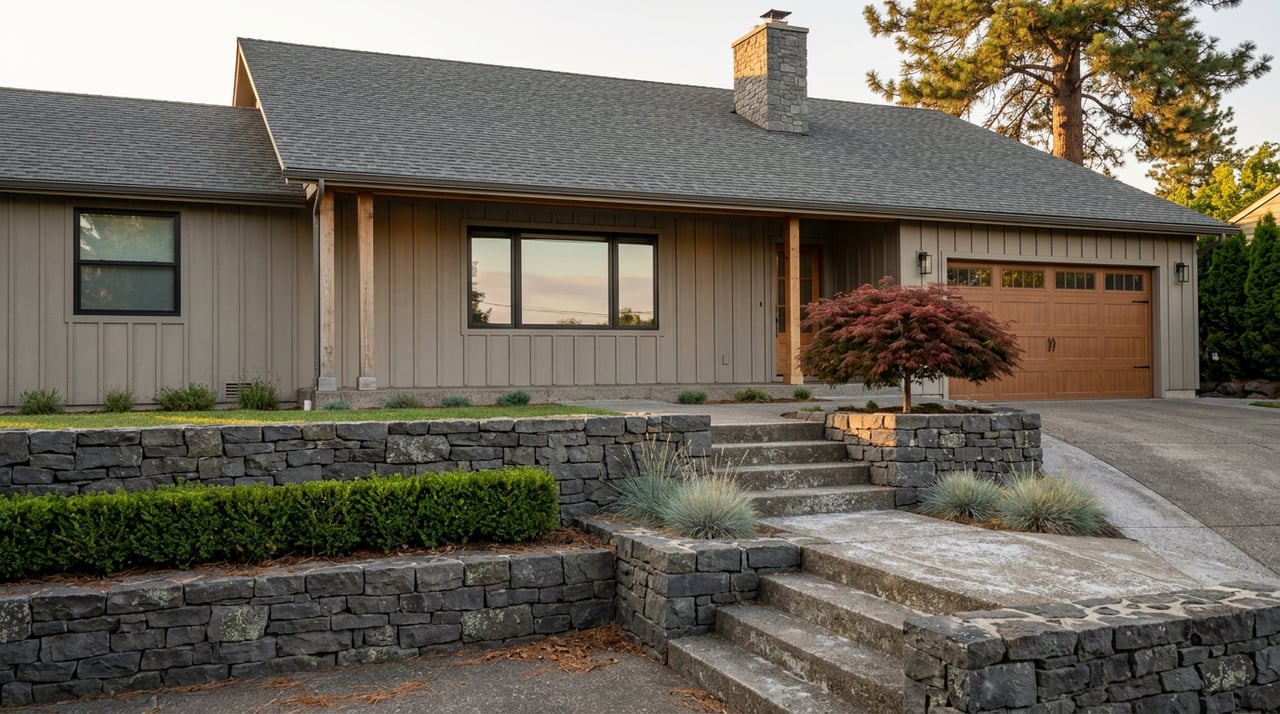
Spokane's rock-wall trade has clearly organized itself around this terrain. Rock Placing Company, started by Terry Frost in December 1998, has grown into one of the bigger boulder-wall and natural stone outfits serving the region, the kind of scale that tends to build up in a market where hillside walls are routine rather than occasional. Landsite Development has been in the business of building and fixing boulder and rock walls around Spokane since 1975, long enough to have worked through multiple versions of the county's slope rules. Local firms tend to favor boulder or dry-stack basalt construction over poured concrete in part because those gravity walls come with drainage gaps already built into the stacking, a detail that matters more on a hillside lot than a flat one.
None of that expertise removes the county's review step. It just means a South Hill homeowner is more likely to find a contractor who has already been through it.
On cost, the most recent local figures available come from Homeyou, a home-improvement pricing site, which reports an average Spokane-area retaining wall running between $2,593 and $3,717, with a full range from $903 to $6,774, based on 159 completed local jobs tracked through the middle of 2025. That is a useful baseline for a straightforward wall built on stable ground. It says nothing about what happens once engineering review enters the picture. Industry cost guides tracking concrete retaining wall projects nationally put stamped structural drawings at an additional $2,000 to $5,000 on top of standard construction pricing, a figure worth treating as a general planning range rather than a Spokane-specific quote, since it was not measured locally.
What This Means If You're Looking at a South Hill Lot
A standard home inspection will look at grading and any retaining wall that affects the dwelling, checking for signs that water is finding its way toward the foundation. That is a real and useful check, but it is a visual one. It will not tell a buyer whether the backyard's grade crosses the county's 30 percent threshold, because that is a measurement question, not a moisture question.
Three things are worth doing before assuming a sloped South Hill yard is a simple project:
Check the parcel's slope through Spokane County's own property records before falling for a listing photo of a dramatic hillside yard. The city's own permit guidance points residents toward the county's parcel dashboard as the starting point for exactly this kind of question.
Ask whether any existing wall on the property was permitted. An unpermitted wall built years ago is not automatically a problem, but it is a question worth asking before you inherit it.
If you are planning to add a wall, patio, pool, or addition on a visibly graded backyard, get a slope read and a rough sense of whether the county's Geo-Hazard Mitigation Plan applies before you sign a construction contract, not after. Finding out mid-project is the version that costs both money and time.
South Hill's terrain is part of what makes the neighborhood look the way it does, from Cannon Hill Park's stone bridges to the basalt-clad homes still standing from the Craftsman era. That same terrain is also a line item that only shows up once you go looking for it. Buyers who check the slope before they fall for the view tend to have a much better time than buyers who find out at the permit counter.
If you are weighing a South Hill property, or trying to figure out what a sloped lot would actually cost to build on, Alejandro Ventura can walk through the specifics with you. Let's Connect and talk through what a particular lot's grade means for your plans before you make an offer.